Youtube Scliterbahn Delayed Veruct Oeong Again
Information technology was a Sunday afternoon, August seven, 2016, the temperature a pleasant 78 degrees, equally 10-year-one-time Caleb Schwab began the 264-step climb to the elevation of Verrückt, the world's tallest waterslide, which loomed like a colossus over the forty-acre Schlitterbahn Waterpark in Kansas Urban center. Caleb was a chocolate-brown-eyed boy, his nose dotted with freckles. He had come up to the park with his male parent, Scott, a land legislator; his mother, Michele; and his iii brothers. That twenty-four hour period, Schlitterbahn was offer free admission to Kansas elected officials and their families, forth with a buffet tiffin, and the Schwabs, who lived in the town of Olathe, southwest of Kansas City, were thrilled. A free day at Schlitterbahn. What could be improve?
The Kansas City Schlitterbahn is one of five Schlitterbahn parks in the country. The others are in Texas: in New Braunfels, South Padre Island, Galveston, and Corpus Christi. Every year, an estimated 2 million visitors go to the parks to plunge down slides, zoom through twisting tube chutes, and float and swim in man-made rivers and enormous pools. For the virtually devoted fans, Schlitterbahn is an aquatic version of Disney World, with something for anybody, from huge playgrounds for children to swim-up bars for adults that serve beer and margaritas. Some "Bahnophiles" spend every summertime weekend, or even entire vacations, at a Schlitterbahn.
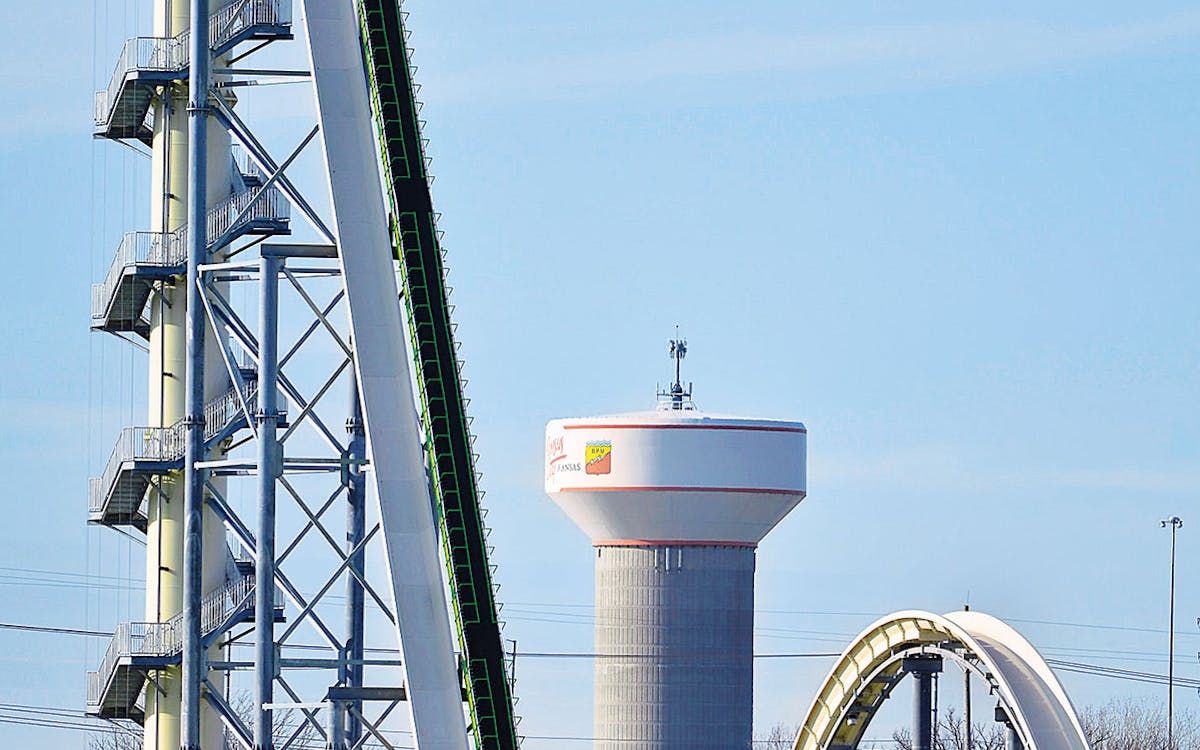
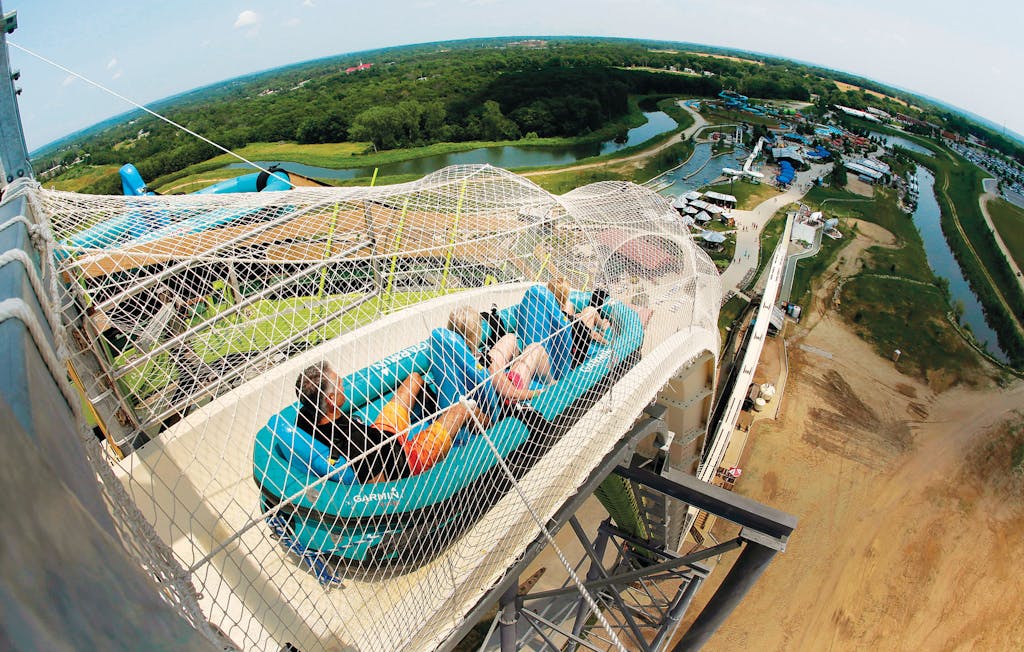
And in Kansas City, even those who cared piffling for water or who couldn't afford Schlitterbahn'southward $45 admission ($35 for children) would drive by the park just to go a look at Verrückt. At 168 anxiety 7 inches tall, Verrückt, which means "insane" in German language, was taller than Niagara Falls. 3 riders within a rubber raft would plummet down a nearly vertical seventeen-story drib at speeds reaching upwardly to 68 miles per hour. The moment they reached the lesser, they would shoot upward a 55-foot-tall incline—the equivalent of a v-story edifice—before racing down ane last steep slope, finally coming to a cease in a long, water-filled runout.
The idea for Verrückt came from 63-twelvemonth-old Jeff Henry, who co-owned the Schlitterbahn parks with his older brother, Gary, and younger sister, Jana, and acted every bit the company's chief visionary, a conjurer of splashy joyrides. In the water park business organization, Jeff was considered a genius of sorts—"an out of the box visionary of waterpark designs," wrote Tim O'Brien in his 2006 book Legends: Pioneers of the Amusement Park Industry. Jeff often said that his goal in life was to brand Schlitterbahn customers happy—"to put a smile on their faces, to give them a thrill or two," he told me during one of our conversations this summertime. "I'thou a h2o showman. That'southward what I do."
And Verrückt, a ride that lasted only eighteen seconds, was considered to exist his crowning accomplishment. When the slide opened to the public, in July 2014, riders' reviews were a publicist'southward dream. ("Near astonishing ride I've ever ridden." "Like dropping out of the sky." "Terrifying and horrible and terrific.") By the fourth dimension young Caleb climbed Verrückt's stairs, some 100,000 adrenaline junkies, a few of whom had flown in from across the world, had ridden Verrückt, and Jeff was planning to build a second version of the slide at the Schlitterbahn in Galveston.
Co-ordinate to park rules, a Verrückt passenger had to be at least 54 inches (iv feet 6 inches) tall. Caleb was 4 feet xi inches tall and weighed 72 pounds. He told his parents he had to endeavour information technology.

When Caleb reached the tiptop of the platform, he could run into the sprawl of Kansas Urban center, including the downtown skyline, some sixteen miles away. He stepped into the front of the raft, and an employee secured him to his seat with a Velcro belt and a shoulder strap. Behind him were 2 young women—one 32 years quondam and the other 25—sisters who lived near the Kansas-Nebraska land line. It was tranquillity. The sounds of the park below—laughter and shouting—were nothing more a faint murmur.
The gate swung open, and the conveyor belt underneath the raft began to movement. The raft tipped forward. All of a sudden, information technology was hurtling downward: it must accept felt to Caleb every bit if he'd fallen off a skyscraper. Within a few seconds, the raft reached the bottom of the loma and swooped up the 2nd, 55-pes hill. Merely instead of staying in its fiberglass flume and cresting the colina, the raft flew upward into the air. Caleb's head collided with a net and a semicircular metal hoop that arced over the top of the slide. The hoop sliced into his neck, and he was instantly decapitated. His caput and body flew out of the raft and landed on the chute.
Waiting for Caleb at the bottom of Verrückt was one of his brothers, forth with numerous spectators. As the boy's small corpse slid toward the runout pool, anybody began to scream. Onlookers prevented Caleb's mother from witnessing the scene. "It was as horrible a moment as you could imagine," a person who was at that place told me. "A nightmare across comprehension. I can't brainstorm to describe information technology."

A half century earlier, in 1966, a Houston accountant named Bob Henry told his wife, Billye, that he was tired of city life. He said he wanted to enhance their three children in a small town, simply equally he had been raised.
Leafing through a newspaper, Billye spotted an ad for a belongings called Camp Landa, a small-scale thirteen-acre campground with some sagging frame cabins that was for auction in the Hill Country town of New Braunfels, thirty miles n of San Antonio and 50 miles s of Austin. Bob, Billye, and the kids—Gary, Jeff, and Jana—piled into the family unit'southward Ford station wagon and drove to the Landa to give it a await. The camp sat adjacent to the spring-fed Comal River, which gently meanders two and a half miles through New Braunfels before merging with the Guadalupe River. Century-sometime cedar, oak, and cypress trees were scattered throughout the camp. A light cakewalk rattled the leaves. "This is paradise," Bob said, and he struck a deal to buy the Landa that day.
The Henrys moved into a modest business firm on the property, which they renamed the Landa Resort. Billye ran the buffet, and Gary, Jeff, and Jana did odd jobs: sweeping out the cabins, mowing the grass, laying brick, shingling, and grouting. To attract more customers, Bob erected 2 slides that dumped guests into the Comal.
"I ever set out to suspension all the records. I desire to be the get-go at the bar to buy a drink, and I want to be the outset to see a pretty girl, and I want to be the outset at everything. I want to have the biggest, the tallest, and the fastest rides at my parks."
Like his father, Gary, the eldest kid, had a sharp, belittling mind. He would subsequently nourish the University of Texas and major in accounting. Jana, the youngest, would attend what was then known equally Southwest Texas State Academy, in nearby San Marcos, and major in mode merchandising. Only Jeff, the middle child, wasn't interested at all in a formal education. As a boy, he was the classic river rat, a Huck Finn in cutoff shorts who spent about all his free fourth dimension on the Comal. He swam, fished, canoed, rafted, and hunted for turtles. He pedaled his bicycle beyond town to buy busted car-tire inner tubes at gas stations, which he patched up and rented to tourists who wanted to bladder the river. He gave river tours, and he operated a petting zoo. "Thank you for bringing me hither," he once said to his dad. "This is the all-time life I could ever imagine."
Jeff was so busy with his ain projects that he barely had time to go to New Braunfels High Schoolhouse, and when he did, he often showed up for form barefoot. He was smart, and he joined the argue team, but he didn't turn in his homework and refused to have tests, telling his teachers that tests were a waste of time. During his senior year, the school superintendent went to his father and said, "Bob, I take to be honest. We're not sure how to handle Jeff." According to family unit legend, the superintendent then handed Bob a diploma. "Tell Jeff nosotros're going to allow him graduate and then that he no longer has to come back to school."
After high schoolhouse, Jeff opened a video arcade bar in San Marcos that he called the Too Biting Bar, the walls of which contained painted murals of moons, watermelons, lips, and bananas. He likewise kept working for his begetter. Around this time he noticed that some of the people going downward his male parent's slides were hitting the h2o too hard. And so he invented what he described as a "h2o brake," a dip at the end of the slide that slowed the guests downwards.
In 1977, when he was 22 years old, he took a trip with a buddy to Orlando, Florida, where he visited two newly opened water parks: Wet 'north Wild and Disney's River Land. (At that point, there were fewer than a half-dozen water parks around the U.S.) Jeff rapidly got on the telephone to tell Bob and Billye all nigh it. "He had the ability to meet what other people were doing then have that to the side by side level," Gary told me. "And he saw before anyone else what we could do in New Braunfels."

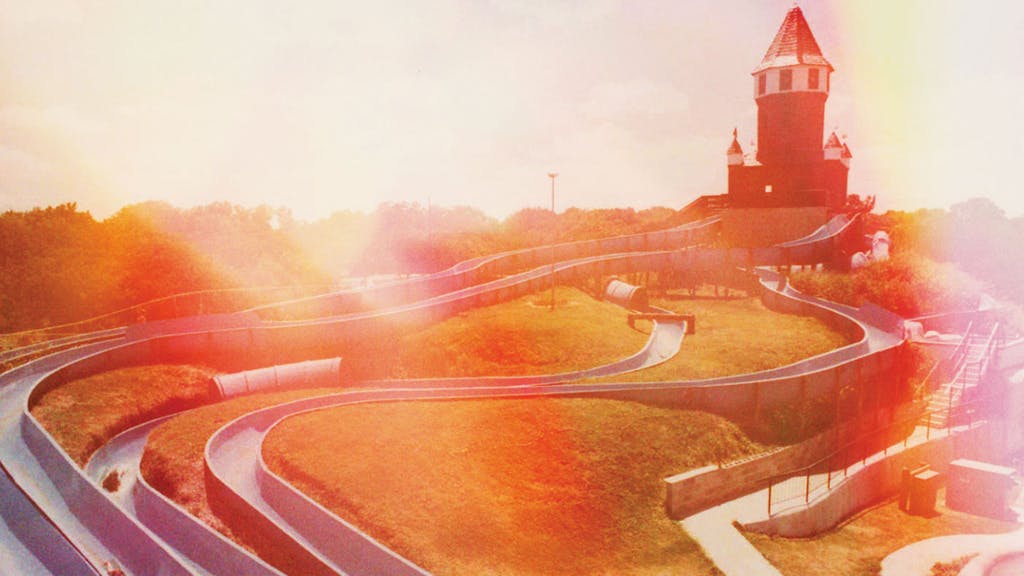
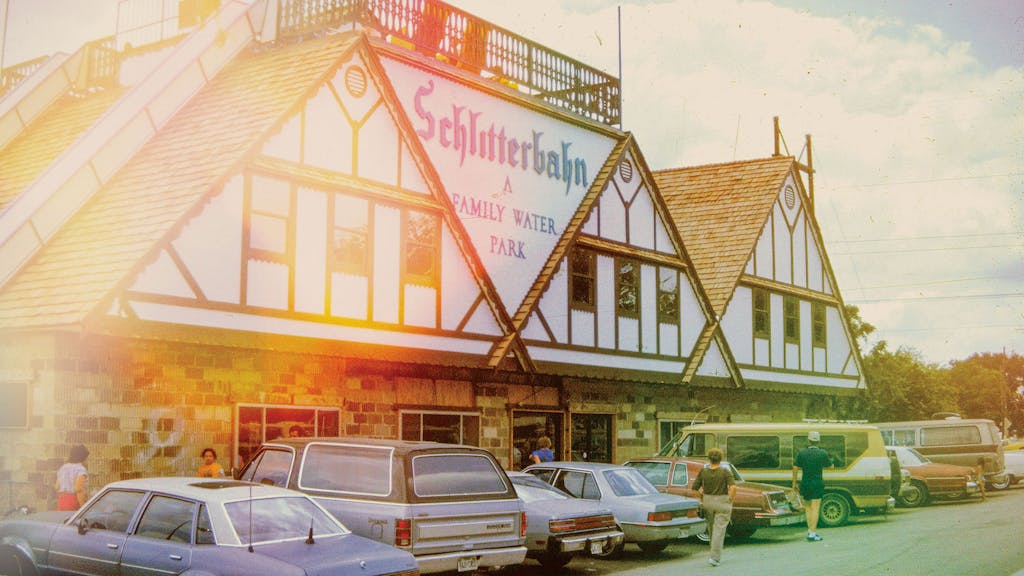
Bob loved the idea of a water park. He bought a piece of property side by side door to the Landa, built a threescore-human foot replica of a High german castle (to reflect New Braunfels'south heritage), and had four blueish fiberglass waterslides erected around the castle. He named the park Schlitterbahn, which means, roughly, "glace road" in German, and hired his children to help him manage it. The placidity, efficient Gary oversaw the park's buildings and finances; Jana handled the marketing; and Jeff was in charge of the attractions.
Schlitterbahn opened in 1979, drawing approximately 5 thou visitors in its commencement flavour (the park is open up total-fourth dimension only from Memorial Day until Labor Day). For Schlitterbahn's 2nd season, Jeff added a 50,000-square-foot pool and an inner tube ride that he named the Hillside Tube Chute. In subsequent seasons, he congenital the Cliffhanger Tube Chute, the Tunnel Tube Chute, and the 45-minute-long Raging River Tube Chute. He encircled the park with a man-made river that behaved a lot like a real river, with light rapids, quick drops, and backwater eddies, and he filled the children'due south playground with fauna sculptures, telescopes, water cannons, behemothic sand buckets, and small slides that sent kids into shallow pools.
By 1990 Schlitterbahn had become a sensation, cartoon nearly 500,000 people a year. Visitors loved the fact that they could park for free and bring their ain nutrient and drinks to the picnic areas. And, of form, they loved Jeff's increasingly daring rides. On a 25-acre piece of property that the Henrys bought, iii blocks east of the main park, he erected ii rides that he had co-created with a former surfer turned inventor named Tom Lochtefeld. The first was the Boogie Bahn, which allowed riders to actually surf on boogie boards over a thin, fast-flowing canvass of water that shot over a sloped surface. The 2d was the Dragon Blaster, a watery version of a roller coaster (a "h2o coaster," Jeff called it), which used high-pressure jets of h2o to push button tubers up and around chutes instead of just sending them straight downhill. Jeff came up with an artificial river that he called the Torrent River, where big waves unexpectedly rose and broke around the tubers. He afterward added some other h2o coaster, the Master Blaster, that was six stories tall and filled with thrilling hairpin turns.
The ride quickly became the park's nigh popular allure.
Despite all his success, Jeff remained, at center, a river rat. Bearded and scruffy, he nearly e'er wore a dirty, creased brawl cap, an old angling shirt, shorts, and muddy boots. He collection an old truck. When he was in meetings, he pulled off his boots and propped his bare feet up on the table. He apparently enjoyed smoking pot. (In 1994 he pleaded guilty to third-degree felony drug possession after he was caught with seventeen ounces of marijuana.) And he was sometimes as obstinate with coworkers as he used to be with his loftier school teachers. "You could be in his presence for thirty minutes and leave disliking him immensely," a water park consultant who worked with him told me. "He e'er thought he was correct."
Even so Jeff made no apologies. He said that if he was demanding and impatient, it was because he was consumed with making Schlitterbahn the all-time water park in the world. In a blackness notebook, he constantly wrote downwardly ideas for new rides he wanted to build. To go even more ideas, he pored over the history of Roman aqueducts and leafed through Jules Verne novels. He never got a conventional pedagogy beyond high school and never formally studied physics or engineering. And that never worried the people effectually him. "That would be similar someone existence concerned that Nib Gates or Mark Zuckerberg doesn't take a college caste," his brother told me. "The people that have a spark of genius don't necessarily need higher. Plus, Jeff always surrounded himself with other knowledgeable people who were able to do the numbers work that he wasn't inclined to practise."
When he wasn't working on Schlitterbahn rides, Jeff exported his inventions effectually the globe. He sold his applied science for slides and river systems to the Atlantis Paradise Isle resort in the Commonwealth of the bahamas and to the Palm in Dubai. In 1989, at a water park in Brazil, he created a 135-pes-loftier slide, chosen Insano, that at the time was the world'due south tallest. (A single passenger, lying on his back, shot straight down the slide, slowed during the long water restriction, and finally came to a stop in a runout pool.) Industry veterans nicknamed him the Lord of the Slides and the Wizard of Wet.
"I ever set out to break all the records," Jeff told United states Today. "I desire to be the first at the bar to buy a drink, and I want to be the first to meet a pretty girl, and I want to be the commencement at everything. I desire to accept the biggest, the tallest, and the fastest rides at my parks."

Had Jeff discovered his natural talents in almost any industry other than h2o parks, he might have had a harder time pushing the limits with his creations. But in the U.S., water park rides are non tightly regulated. Although the federal government's Consumer Production Safety Commission has the authority to set rubber standards for such products every bit baby cribs and bicycles, it has no authority to regulate water parks. That responsibility lies entirely with united states. Some states have agencies that inspect water parks; others rely on the parks' own insurance companies to practice inspections. Texas law, for example, says that a park must obtain a $1 one thousand thousand liability policy for each of its rides and must take all rides inspected one time a year by an inspector hired by the insurance visitor. But there is naught in the law that requires the inspector to have whatever detail certifications. Nor does the law crave an inspector to evaluate the safety of such factors as the ride'due south speed or the geometric angle of its slide path. Co-ordinate to Texas Section of Insurance spokesman Jerry Hagins, the inspector is charged just with making sure that the ride is in sound condition and meets the "manufacturer'south specifications." In other words, a water park is allowed to police itself.
Schlitterbahn initially seemed to be policing itself just fine. In 1998 the New Braunfels Schlitterbahn was named the country'south Best Waterpark in a poll conducted by Amusement Today. Sensing opportunity, the Henrys opened a Schlitterbahn in S Padre Isle, in 2001. Jeff's job was to fill the park with new attractions, and he didn't disappoint. He devised a complicated bogus river system that moved tubers from one major slide to the adjacent then they would rarely need to go out the water to stand up in line.
In 2006 the Henrys expanded again, opening a year-round park in Galveston with a retractable roof. By and so, developers from around the country who also wanted a Schlitterbahn were regularly approaching the Henry family with proposals. Ane of the most intriguing came from a Kansas City investor. He asked the Henrys to build a Schlitterbahn water park in Wyandotte County, Kansas, which covers the western half of metro Kansas Metropolis. The plans would eventually telephone call for hotels, rental cabins, hundreds of thousands of foursquare anxiety of retail outlets, and a residential area surrounding the park. To get the project going, a real estate investment trust offered to loan the Henrys $174.3 million. The Land of Kansas besides agreed to throw in an estimated $200 meg in sales revenue enhancement revenue bonds. These were Disneylike numbers. Schlitterbahn was inbound the big leagues of American amusement.
The deal was announced in 2005, but because of a fatigued-out structure procedure, every bit well as the economic downturn of 2008, the venture had to exist scaled back significantly, with no hotels, no homes, and little retail. When the park opened in 2009, expanses of dirt surrounded much of it. Industry insiders said the Kansas City Schlitterbahn needed a jolt—something big, really large—that would help information technology alive upward to the early hype and investment.
In October 2012, Jeff was at an amusement park industry trade evidence with his principal collaborator, John Schooley, a soft-spoken, silver-haired one-time yacht builder who had constructed slides at h2o parks in Asia before coming to New Braunfels to piece of work for Jeff in 1998. The two men were approached past producers from the Travel Channel who said they were looking for an episode to lead off the new season of their pop Telly series Xtreme Waterparks. They asked Jeff if he had any projects in the works.
Jeff, who has a streak of P. T. Barnum in him, all of a sudden blurted out that he and Schooley were going to build the globe's tallest and fastest waterslide at the Kansas Metropolis Schlitterbahn.
This was news to anybody, even at Schlitterbahn. For nearly a decade, Jeff and Schooley had been working on what they chosen a cannon nozzle: a highly pressurized h2o nozzle, much more advanced than the ones used in the Dragon Blaster and Master Blaster, that would propel riders up higher hills. They had no immediate plans to build a ride using the cannon nozzle, and certainly had no plans to build it in Kansas City, until Jeff made his pronouncement to the Travel Channel producers. "Something clicked in my caput, and I just re alized the time had come to exercise it," he told me later on.
He returned to Texas and met with Gary and Jana. (By this time, Bob had handed off the visitor to his three children, giving each of them a third of the voting shares.) He sketched out his program for Verrückt: a ane-of-a-kind slide that would non merely send riders most straight down a staggeringly alpine hill but also shoot them up and over a second imposing hill, giving people multiple center-stopping thrills. The slide would become the talk of the amusement park industry, he said.
Gary and Jana agreed that Jeff should keep with Verrückt. Soon, reporters from an array of media outlets—Us Today, Wired, ESPN'southward Grantland, even Smithsonian magazine—were calling to ask Jeff almost his latest gamble, and he was always ready with a good quote. He told one reporter that Verrückt was "an erotic piece of art" and would go downwardly in history as "the most terrifying ride ever congenital in a water park." He told some other reporter that he had conceived of Verrückt because he could no longer tolerate the thought of the world'due south tallest slide being in Brazil. (Subsequently he had created the 135-foot Insano, a Brazilian company congenital a body slide that was just under 164 feet.) "I'm from Texas," he said later. "It was a matter of pride."
Jeff never made any secret of how he congenital his rides. As he told Legends writer O'Brien, he relied on "trial and error, because no models of what was 'supposed' to exist done existed at the time." Sometimes he'd change his mind about a ride as he was building it and redesign it on the spot. If the completed ride still didn't encounter his expectations, he'd tear it down and start over. "You go dorsum, you fix it, yous make it work, you lot go along it safe," he said.
To brand Verrückt work, Jeff and Schooley (who also had no formal engineering credentials) and their staff were going to have to figure out the precise details of everything from the slope of Verrückt'due south hills to the size of the rafts. They would need to determine what the minimum and maximum weights of the passengers in each raft should exist, and they would need to observe out what gravitational and centrifugal forces those passengers would be able to sustain. They would have to study such factors as the consequence of water friction and even wind velocity on the rafts. And as if that wasn't enough, they were going to accept to invent a special conveyor arrangement to ship the rafts dorsum up to the top of the platform.
Although Jeff and Schooley said they used engineers and architects to assistance them design Verrückt, they also continued to depend on traditional trial and error. In a field near Schlitterbahn's corporate headquarters, in New Braunfels, they synthetic a small model of Verrückt, one twelfth the size of the real thing, and they sent a model auto down the slide, along with cantaloupes and watermelons, to test it. They next built a ninety-foot-alpine model of Verrückt (about one-half its eventual size), putting the initial drop at a sixty-degree vertical angle, which they believed was steep plenty for the riders to experience as if they were falling just was however gradual enough for the rafts to maintain solid contact with the chute. Followed by a camera crew from Xtreme Waterparks, Jeff and Schooley loaded a raft with sandbags and sent it down the slide. Everything went fine until the raft reached the height of the second hill. It lifted off the chute and went airborne, landing several yards away.
To tedious the rafts' velocity, Jeff and Schooley lessened the bending at the lesser of the initial drib. They then headed to Kansas City to build the 168-pes, vii-inch Verrückt. But with cameras still rolling, more than sandbag-laden rafts continued to fly into the air. The Travel Channel crew asked Jeff why the slide was not working. "I'm not quite sure even so," he replied. "There'southward a whole bunch of factors that crept in on this ane that we just didn't know about."
Whenever he did interviews for the Idiot box evidence, Jeff seemed obsessed with Verrückt, as if it were his white whale. "Verrückt could hurt me; it could kill me. It is a seriously unsafe piece of equipment today because there are things that we don't know about it," he said at one point. "If we mess up, it could be the cease. I could die going down this ride."
Jeff told me later that he was making such statements only at the behest of the TV producers. "They wanted me to create suspense and danger, to make Verrückt expect actually scary to add drama to the show," he said. "Yous know the [raft] that went airborne on our ninety-foot model in New Braunfels? Information technology was faked. We added Rollerblade wheels to the gunkhole to make it fly off."
Mayhap so (the Travel Aqueduct declined to annotate), merely even if Jeff had been playacting for the cameras, there was something about Verrückt that bothered him. On April 25, 2014, Jeff climbed to the top of the Verrückt tower with Kansas governor Sam Brownback and officials from Guinness World Records, who proclaimed that Verrückt was indeed the tallest waterslide in the world. A few days later, Jeff ordered that 2 thirds of the slide be dismantled. It all the same wasn't working, he said. Tests were showing that the rafts were going likewise fast and the g-forces were so powerful that passengers might pass out. ("Even an astronaut couldn't handle it," Jeff later told me.)
"Human being, are they hitting that net up there? That gunkhole flew. That boat looked like information technology flew."
He and Schooley added an extra five anxiety of height to the second hill to slow riders downwards and decreased the angle of its descent. Finally, in June 2014, after several successful sandbag runs, they decided it was fourth dimension for humans to ride it. Jeff, Schooley, and the blood brother of Jeff'south assistant piled into a raft. Jeff was wearing cowboy boots. "Well, man, if I don't always see you once more, it'south been fun," he said to Schooley, trying to be lighthearted. Just at least one of the men was clearly nervous. "If you see a couple of people [become downwards the slide], you say it's survivable," Schooley later told a reporter. "Just the first time, you don't know. Y'all actually don't know."
On their first effort, the cannon nozzle misfired, and the raft never made information technology up the v-story hill: information technology slid dorsum down to the bottom. They walked up the stairs to try the ride again. This time, it worked perfectly. When they reached the runout puddle, the three men in the raft shouted and pumped their fists in the air.
Over the adjacent several days, more Schlitterbahn employees rode Verrückt without bug, and on July 10, after xxx months of work, the slide opened to the public. Numerous media outlets, including NBC's Today Show and ABC's Good Morning America, were there to capture the festivities.
People got in line to ride Verrückt. There was no age restriction—only the acme requirement—so kids joined the line. The riders were divided into groups of iii and ordered to step on a large scale. If the full weight of the iii riders was betwixt 400 and 550 pounds, they were sent up the stairs. At the top of the platform, they were weighed again and placed in a raft. An employee pushed a button, and the raft would take off.
That 24-hour interval, the Travel Channel's cameras focused on Jeff and Schooley as they stood on an elevated platform almost Verrückt'southward second loma. During structure, the men had ordered that a net be placed to a higher place the chute, propped upward every few feet past semicircular poles, to keep people from flight out. (The same netting system had been placed on Schlitterbahn's Primary Blaster rides.) As they watched one raft crest the hill, Jeff turned to Schooley and said, "Man, are they hit that internet upwardly there? That boat flew. That boat looked like it flew."
Once again, Jeff later insisted to me that he had been hamming it up for the camera and that he did not in fact encounter a raft fly off the chute on opening day. Indeed, for the adjacent two years, there were no public indications that Verrückt had any bug at all. So many Schlitterbahn customers wanted to go down the ride that park officials began requiring them to sign up for time slots.
Then, on August 7, 2016, Caleb Schwab and his family arrived at the park.
At Caleb's funeral at the LifeMission Church in Olathe, five days subsequently his death, the grief among the mourners was overwhelming. Some of his baseball game teammates saturday in the front end row, wearing their jerseys. At the end of the service, Caleb's male parent asked the boys to gather at the front end of the church and do a final huddle in honor of his son.
The Henrys made no public comment. All that came from Schlitterbahn was a argument from company spokesperson Winter Prosapio, who said, "We honestly don't know what happened." She added that Schlitterbahn was "securely and intensely saddened for the Schwab family and all who were impacted by the tragic blow."
Kansas Metropolis reporters began excavation. They quickly learned that their state, similar Texas, allows h2o parks to be self-inspected. (Under the headline "The making of Schlitterbahn's Verrückt water slide: Too much, too fast?" a Kansas Metropolis Star article concluded that "the ultimate safety of [Verrückt] mostly began and ended with those inspired to build information technology.") The reporters quoted former Verrückt riders who said their shoulder straps had busted loose or that their rafts had caught air. "Our boat 1 hundred pct went off the tracks," one adult female said. A local TV station interviewed a former park lifeguard who said Verrückt had terrified him and his coworkers."We had to ride it three times earlier we actually opened the park every twenty-four hour period," Nathan Campbell said. "[Schlitterbahn managers] would ask lifeguards who would want to volunteer, and no one would put their hands up . . . Information technology was similar, 'No, I don't want to practice it.' ''
Investigators and detectives from the Kansas Metropolis Police Department, the Kansas Agency of Investigation, and the Kansas chaser general'due south function also arrived at Schlitterbahn. A detective interviewed 29-year-former Tyler Miles, who had been working at the park since 2013 and had advanced from construction worker to lifeguard to director of operations, responsible for all aspects of the park's twenty-four hours-to-day ride operations. "Accept you been enlightened of whatsoever complaints regarding Verrückt the ride in the last season?" the detective asked.
Miles answered, "I have not, sir," according to the detective. His lawyers would afterwards say he was then confident in the ride's safety that on the very mean solar day that Caleb was killed, he had brought his wife to the park to ride Verrückt.
Investigators laterlearned, nevertheless, that Schlitterbahn employees were required to submit regular "ops reports" about the rides they monitored and, co-ordinate to reports that the investigators read, Verrückt had issues that were never revealed to the public. For example, 11 Schlitterbahn customers said they had been injured on Verrückt betwixt August 31, 2014, and August v, 2016 (ii days before Caleb'south death). In five of the incidents, riders claimed they were injured while their rafts were still in the chute. (Ane passenger reported that her caput had slammed into the headrest and she sustained a concussion when her raft entered the runout pool at a high speed.) In v other incidents, riders claimed their rafts went airborne over the crest of the second hill and that they suffered head, cervix, and back injuries when their rafts slammed back down onto the chute. And a man named Norris "J. J.'' Groves reported that when his raft went airborne, his face and forehead struck the netting and a metal hoop, causing his right heart to slap-up shut for the remainder of the twenty-four hour period.
An investigator spoke to a seventeen-year-old lifeguard who said that Miles had ordered him to write a report that downplayed the severity of the Groves incident. Meanwhile, sifting through Verrückt's maintenance reports, other investigators concluded that Miles had avoided or delayed making repairs that would have taken the ride out of committee. According to investigators, Miles hadn't even ordered repairs when a Schlitterbahn director informed him, on July 15, 2016 (three weeks before Caleb'south death), that maintenance work on Verrückt'due south restriction arrangement was a priority.
What's more, according to court documents, the investigators learned that on July iii, 2014, 1 calendar week before the ride'southward grand opening, an applied science business firm hired by Jeff and Schooley to perform accelerometer tests on Verrückt's rafts had issued a report suggesting that if the combined weight of the three passengers in a raft was between 400 and 550 pounds—the weight Jeff and Schooley had agreed was advisable—at that place was a risk the raft would go airborne on the 2nd hill. The ride opened anyway, with the weight range unchanged.
By 2017, attorneys for Schlitterbahn were meeting with the Schwab family's attorneys. They somewhen agreed that the water park and various companies associated with the design and construction of Verrückt would pay Caleb'south family unit a $20 million settlement, an astonishing sum. The two sisters who had ridden backside Caleb, both of whom suffered facial injuries, also received a settlement, of an undisclosed amount.
Still, neither Jeff nor his siblings offered any public explanation for what had happened. Had at that place been a trouble with the distribution of the three passengers' weight that acquired the raft to lift off into the air? Had something gone incorrect with the cannon nozzle that shot the raft up the 2d loma? Was the wind a cistron? No 1 seemed to know, not fifty-fifty Jeff.
He said he wanted to return to Verrückt, which closed immediately after Caleb'southward expiry but yet loomed over the Kansas City landscape like some grisly monument, and then he could notice out what had gone wrong. His hope, he said, was to reconstruct the fatal ride exactly as it took identify, assisted past a team of independent experts. Just prosecutors for the Kansas attorney general'southward part persuaded a judge to lock downwardly the ride. They believed it was a valuable piece of evidence that should not be touched. Schlitterbahn was perhaps non the scene of a freak horrific accident, the prosecutors were maxim, but the scene of a offense.

This past spring, Kansas Urban center prosecutors began meeting with a grand jury, and in late March, the jury issued indictments. When Jeff and Schooley erected Verrückt, the state charged, they had knowingly created a "deadly weapon." Instead of using cardinal mathematical and physics calculations to design and build the ride, the two men had "rushed forward relying almost entirely on crude trial-and-error methods." And although they realized that their finished product "guaranteed that rafts would occasionally get airborne in a manner that could severely injure or kill the occupants," they went ahead and opened the ride anyhow. To make matters worse, the grand jury charged, operations director Miles had deliberately curtained evidence about Verrückt's dangers, going so far as to give a law detective simulated information.
Miles and the Kansas Metropolis Schlitterbahn itself were indicted for aggravated battery, aggravated endangerment of a child, interference with law enforcement, and involuntary manslaughter. Jeff, Schooley, and Schlitterbahn'due south New Braunfels–based structure visitor, Henry & Sons Construction, were charged with aggravated battery, aggravated child endangerment, and 2nd-degree murder, a much more than significant charge than manslaughter that could upshot in sentences for Jeff and Schooley ranging from nine to 41 years in prison house, along with a $300,000 maximum fine per man.
Once again, Jeff and his siblings had no public comment, though Prosapio released some other argument that said that Schlitterbahn was "shocked" by the indictments. "The allegation that nosotros operated, and failed to maintain, a ride that could foreseeably cause such a tragic accident is beyond the stake of speculation. Many of u.s.a., and our children and grandchildren, have ridden the ride with consummate confidence as to its safe . . . We run a rubber operation—our 40 years of entertaining millions of people speaks to that."
All the defendants pleaded not guilty in a Kansas courtroom. Before Jeff's arraignment, his 39-year-one-time daughter, Amber, from his kickoff matrimony, raced to a Walmart and purchased a suit for her father to habiliment. He posted a $500,000 bond and surrendered his passport. Equally he walked out of the courthouse, his face ashen, a reporter asked if he had whatever preparation in engineering or physics. "No comment," Jeff said. But one of his lawyers acknowledged that Jeff didn't take such grooming. He added, "Neither did Henry Ford, and he built the car."
Jeff returned to Texas and stayed out of public view, splitting his fourth dimension between a condo he owns in South Padre and a habitation he owns outside New Braunfels on a remote slice of property a short walk abroad from the grave sites of his mother and father. (Bob died in October 2016, after a long illness, and Billye died in her sleep final yr.) He stopped going to whatever of the Schlitterbahn parks he created, and the company laid off nearly of his blueprint and construction staff. He endured another jolt of bad publicity when the news media learned about his marijuana apply. (Besides the felony conviction in 1994, he was convicted in 2007 on a misdemeanor charge of possession.) Reporters from the San Antonio Express-News also revealed that in September 2013, Jeff'southward second wife, Louise Settree, had claimed in divorce papers that he had "assaulted, battered, trounce and tormented" her during their about five-year union and that his use of alcohol and drugs had contributed to the "horrific assaults." His treatment of her, Settree claimed, was "so extreme in degree . . . equally to be regarded as atrocious and utterly intolerable in a civilized community." (Jeff's attorney dismissed her accusations, claiming that such statements are mutual in contentious divorce proceedings.)
On June 16 of this year, after I'd attempted to contact Jeff a vi times through his legal squad and his family, he called me at ane:26 in the morning. When I returned the call several hours later on, merely subsequently 7 a.m., he picked up on the first ring. He sounded utterly distraught. "If I actually believed I was responsible for the death of that niggling male child, I'd kill myself right now," he said. He seemed close to tears. "There are members of my family who would like to commit me to a facility because I'm suffering from depression. Sometimes I can't go out of bed for four days."
He had decided to talk to me, he said, so that people would sympathize he had done nothing incorrect. Over the next ii days, we spoke four times, despite his lawyers demanding we end. "How do you indict someone for murder if you don't know what happened?" he asked at one betoken. "How is that possible?"
Jeff said that soon afterwards Verrückt was up and running, he had left Kansas Metropolis to do some piece of work on a Schlitterbahn park in Corpus Christi, which had opened in 2014, and he had never gone dorsum. He said that he was never told near the eleven injuries on Verrückt prior to Caleb'due south death, nor was he told about the 2016 maintenance problems. "If any raft had left the surface, that ride should accept been shut down, and I would have gone straight there to figure out what was wrong," he said. "But nobody bothered to tell me something was wrong with it."
As for the exterior engineering firm'south finding that a raft with three passengers weighing between 400 and 550 pounds could go airborne, Jeff said he thought it relied on outdated data. He also heatedly denied allegations that he had been worried about Verrückt'southward dangers as he was building it, chuckling mirthlessly when he told me he'd been acting when he made his fearful on-camera comments, a few of which were quoted verbatim in the indictment. "The real Jeff Henry was not indicted. The actor Jeff Henry, who was trying to glamorize the ride, was indicted."
Verrückt, he told me, "is the state-of-the-fine art engineering science. I thought we had designed the biggest, blue-chip thing e'er built, a ride that could operate safely and never have a serious accident, ever, if things were complied with and if the matter was maintained and operated every bit designed. I'grand telling you, the ride that was built by John Schooley and Jeff Henry is not the aforementioned ride that that male child was on the day he died."
When the example goes to trial, which isn't likely to happen for at least some other twelvemonth, Jeff's and Schooley'south attorneys might use that very statement: that the employees who operated Verrückt fabricated mistakes, such as ignoring maintenance issues, and that Henry and Schooley knew nothing about it. And the lawyers could argue that the two men were non criminally negligent. To take committed a offense, they would have had to have known that their actions could result in injury or death.
But prosecutors could tell the jury that Jeff and Schooley knew very well that Verrückt could atomic number 82 to a catastrophe, yet they continued to push frontward. Consumed with hubris, they were determined to exist known as the creators of the tallest and fastest ride in all of water park history.
Schlitterbahn, meanwhile, is reeling. Plans to expand to other cities have been shelved. EPR Properties, the real estate investment trust in Kansas Urban center that loaned Schlitterbahn $174 million for its Kansas park, has warned its investors that the criminal indictments could injure Schlitterbahn's chances of repaying its loan, which might strength EPR to foreclose on the park, along with the parks in New Braunfels and S Padre Isle, which had been put upwardly as collateral for the loan. Last year a bank in Corpus Christi that held roughly $32 million in debt on that urban center's Schlitterbahn took ownership of the park, afterwards plans for an attached resort quintupled in size and the projection's costs ballooned, somewhen forcing the belongings into foreclosure. (Schlitterbahn continues to manage the park.)
"It'southward a tragedy," Jeff told me. "We were a Texas tradition, and now it'due south over."
When I later asked his blood brother, Gary, about Jeff'southward comments, he quietly said, "It has been a horrific couple of years." But he added that Schlitterbahn is not going out of business organization. (And he did go good news in July, when prosecutors agreed to let the visitor tear downward Verrückt this fall.) "I get up every day and call up almost all the slap-up people who work at Schlitterbahn," he said. "I think about all the great customers who choose to come to a Schlitterbahn to spend their family vacations. I get fired up to come up to work and accept intendance of those customers."
I recently collection to the original Schlitterbahn, in New Braunfels. It was a gloriously sunny afternoon, the kind tailor-fabricated for Jeff'south innocent old vision of summer fun. Families poured through the gates. Children frolicked in watery playgrounds, teenagers lined up to ride the Boogie Bahn and the water coasters, and parents floated on the artificial rivers. I didn't hear anyone mention the indictments in Kansas City.
I was hoping to encounter Jeff, but he was however staying to himself. His girl Amber did meet me. We walked past the home where Bob, Billye, and the Henry kids lived five decades ago (it'south at present rented out to Schlitterbahn visitors). We stood on the bank of the Comal, where Jeff used to go swimming, and we ambled over to the first tube chutes that Jeff designed and built when he was a immature homo.
For a couple of minutes, I watched some kids zip down one of the chutes, smile from ear to ear. I watched another kids at a picnic table happily downing water ice cream. I listened to the wind rustling through the cedar, oak, and cypress trees, and then I noticed Bister staring at me.
"It'southward sort of cute, isn't it?" she said. Information technology was.
Source: https://www.texasmonthly.com/news-politics/jeff-henry-verruckt-schlitterbahns-tragic-slide/
0 Response to "Youtube Scliterbahn Delayed Veruct Oeong Again"
Postar um comentário