8. a bank sells a treasury bond to the fed. what happens to the money supply?

(Percent change from a year earlier)
Core CPI
Monetary policy of The United States concerns those policies related to the minting & printing of money, policies governing the legal commutation of currency, demand deposits, the money supply, etc. In the United states, the fundamental banking company, The Federal Reserve System, colloquially known as "The Fed" is the budgetary authority.
It is significant to bespeak out that the United States uses a fiat currency as of 1933, whereas from 1873 - 1933 a precious metallic standard or gilt standard was in apply.
The Federal Reserve's lath of governors, along with the Open Market Committee are the principle arbiters of monetary policy in the Us, though the U.S. is unique in that the monetary policy function is ultimately shared forth with the United States Treasury (US Treasury Securities). The Treasury is the penultimate agency on fiscal policy, though it is directly involved in monetary policy through printing & minting federal reserve notes and treasurys.
The Fed is largely concerned with policies related to the issuance of loans (including reserve rate and interest rates), along with other policies that determine the size and rate of growth of the money supply (such as ownership and selling government bonds), whereas the Treasury deals directly with minting and press every bit well as budgeting the government. The U.S. Congress established three key objectives for budgetary policy in the Federal Reserve Act: maximizing employment, stabilizing prices, and moderating long-term interest rates.
Overview [edit]
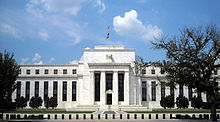
The Federal Reserve Act created the Federal Reserve System in 1913 as the central banking company of the Us. Its chief job is to comport the nation's budgetary policy to promote maximum employment, stable prices, and moderate long-term interest rates in the U.Due south. economy. Information technology is likewise tasked to promote the stability of the financial system and regulate financial institutions, and to human activity every bit lender of terminal resort. [1] [2]
The monetary policy of the United states of america is conducted by the Federal Open Market Committee, which is composed of the Federal Reserve Board of Governors and v out of the 12 Federal Reserve Bank presidents, and is implemented by all twelve regional Federal Reserve Banks.
Monetary policy refers to actions made past central banks which determine the size and growth charge per unit of the coin supply bachelor in the economic system, and which would effect in desired objectives like low inflation, low unemployment and stable financial systems. The economy's aggregate coin supply is the total of
- M0 money, or Monetary Base - "dollars" in currency and banking company money balances credited to the primal bank's depositors, which are backed past the central banking company's avails,
- plus M1, M2, M3 money - "dollars" in the course of bank money balances credited to banks' depositors, which are backed past the bank's assets and investments.
The FOMC influences the level of money available to the economy by the post-obit means:
- Reserve requirements - specifies a required minimum per centum of deposits in a commercial banking company that should be held as reserve (i.e. as deposits with the Federal Reserve), with the rest available to loan or invest. Higher requirements mean less money loaned or invested, helping continue aggrandizement in check. Raising the federal funds rate earned on those reserves also helps achieve this objective.
- Open market operations - the Federal Reserve buys or sells US Treasury bonds and other securities held by banks in exchange for reserves; more reserves increase a banking concern's capacity to loan or invest elsewhere.
- Disbelieve window lending - banks can borrow from the Federal Reserve.
Monetary policy direct affects involvement rates; it indirectly affects stock prices, wealth, and currency exchange rates. Through these channels, monetary policy influences spending, investment, product, employment, and inflation in the United States. Effective budgetary policy complements fiscal policy to support economic growth.
The Federal Reserve's monetary policy objectives to keep prices stable and unemployment low is often called the dual mandate. This replaces past practices under a aureate standard where the main business organization is the gold equivalent of the local currency, or under a gold exchange standard where the business concern is fixing the exchange rate versus another gold-convertible currency (previously practiced worldwide nether the Bretton Wood Agreement of 1944 via fixed exchange rates to the U.S. dollar).
Money supply [edit]
The money supply has unlike components, by and large broken downwardly into "narrow" and "broad" money, reflecting the different degrees of liquidity ('spendability') of each dissimilar type, every bit broader forms of money can be converted into narrow forms of coin (or may exist readily accustomed equally coin past others, such equally personal checks).[3]
For example, demand deposits are technically promises to pay on demand, while savings deposits are promises to pay subject to some withdrawal restrictions, and Certificates of Deposit are promises to pay only at certain specified dates; each tin be converted into money, merely "narrow" forms of money can be converted more readily. The Federal Reserve direct controls but the most narrow form of money, physical greenbacks outstanding forth with the reserves of banks throughout the country (known as M0 or the monetary base of operations); the Federal Reserve indirectly influences the supply of other types of coin.[3]
Broad coin includes money held in eolith balances in banks and other forms created in the financial system. Basic economics likewise teaches that the money supply shrinks when loans are repaid;[4] [five] nonetheless, the coin supply will not necessarily decrease depending on the creation of new loans and other effects. Other than loans, investment activities of commercial banks and the Federal Reserve also increase and decrease the coin supply.[6] Discussion of "money" often confuses the different measures and may pb to misguided commentary on monetary policy and misunderstandings of policy discussions.[vii]
Current state of U.s.a. monetary policy [edit]
In August 2020, after undershooting its 2% inflation target for years, the Fed announced it would be allowing inflation to temporarily ascension college, in order to target an boilerplate of two% over the longer term.[8] [9] It is even so unclear if this change will make much applied difference in monetary policy anytime soon.[10]
Structure of mod US institutions [edit]
Federal Reserve [edit]
Monetary policy in the US is determined and implemented by the US Federal Reserve System, ordinarily referred to as the Federal Reserve. Established in 1913 past the Federal Reserve Act to provide central banking functions,[11] the Federal Reserve System is a quasi-public establishment. Ostensibly, the Federal Reserve Banks are 12 individual banking corporations;[12] [13] [xiv] they are independent in their solar day-to-twenty-four hour period operations, but legislatively answerable to Congress through the auspices of Federal Reserve Board of Governors.
The Board of Governors is an independent governmental agency consisting of seven officials and their support staff of over 1800 employees headquartered in Washington, D.C.[xv] It is independent in the sense that the Board currently operates without official obligation to accept the requests or advice of any elected official with regard to actions on the money supply,[xvi] and its methods of funding too preserve independence. The Governors are nominated by the President of the United States, and nominations must be confirmed past the U.S. Senate.[17] At that place is very potent economic consensus that independence from political influence is good for budgetary policy.[18]
The presidents of the Federal Reserve Banks are nominated past each bank's respective Lath of Directors, just must as well be approved by the Board of Governors of the Federal Reserve. The Chairman of the Federal Reserve Lath is generally considered to have the most important position, followed by the president of the Federal Reserve Banking concern of New York.[17] The Federal Reserve System is primarily funded past interest collected on their portfolio of securities from the The states Treasury, and the Fed has wide discretion in drafting its own upkeep,[xix] but, historically, nearly all the interest the Federal Reserve collects is rebated to the authorities each twelvemonth.[20]
The Federal Reserve has four main mechanisms for manipulating the coin supply. Information technology can purchase or sell treasury securities. Selling securities has the event of reducing the monetary base (considering it accepts coin in return for purchase of securities), taking that money out of apportionment. Purchasing treasury securities increases the monetary base (because it pays out hard currency in exchange for accepting securities). Secondly, the discount rate tin can exist changed. Third, the Federal Reserve can adjust the reserve requirement, which tin can touch on the money multiplier; the reserve requirement is adapted only infrequently, and was concluding adjusted in March 2020, at which fourth dimension it was ready to null.[21] At a reserve requirement of aught, the money multiplier is undefined, because calculating information technology would involve division past goose egg. In Oct 2008 the Federal Reserve added a fourth mechanism by commencement to pay interest on reserves, which i year subsequently the Fed Chairman described as the "most important tool" the Fed could use to enhance involvement rates.[22] [23]
In practice, the Federal Reserve uses open up marketplace operations to influence curt-term involvement rates, which is the principal tool of monetary policy. The federal funds rate, for which the Federal Open Market Committee announces a target on a regular basis, reflects i of the key rates for interbank lending. Open marketplace operations change the supply of reserve balances, and the federal funds charge per unit is sensitive to these operations.[24]
In theory, the Federal Reserve has unlimited capacity to influence this rate, and although the federal funds charge per unit is fix by banks borrowing and lending funds to each other, the federal funds rate more often than not stays within a limited range above and below the target (as participants are aware of the Fed'southward power to influence this charge per unit).
Assuming a airtight economy, where foreign capital or trade does not affect the money supply, when money supply increases, involvement rates go down. Businesses and consumers accept a lower cost of capital and can increase spending and capital improvement projects. This encourages short-term growth. Conversely, when the money supply falls, involvement rates go up, increasing the toll of capital and leading to more conservative spending and investment. The Federal reserve increases involvement rates to combat Inflation.
U.Due south. Treasury [edit]

A United States Treasury security is an IOU from the U.s.a. Government. Information technology is a government debt musical instrument issued past the U.s.a. Department of the Treasury to finance government spending as an alternative to taxation. Treasury securities are often referred to just as "Treasuries". Since 2012 the management of regime debt has been arranged by the Bureau of the Financial Service, succeeding the Bureau of the Public Debt.
Private commercial banks [edit]
When money is deposited in a banking concern, it can then be lent out to another person. If the initial deposit was $100 and the banking concern lends out $100 to some other customer the money supply has increased by $100. However, because the depositor tin ask for the money dorsum, banks have to maintain minimum reserves to service customer needs. If the reserve requirement is ten% then, in the earlier case, the bank can lend $90 and thus the money supply increases by only $xc. The reserve requirement therefore acts as a limit on this multiplier effect. Because the reserve requirement only applies to the more narrow forms of money creation (respective to M1), but does not apply to certain types of deposits (such as time deposits), reserve requirements play a limited office in budgetary policy.[25]
Money creation [edit]
As on Nov 2021 the United states regime maintains over The states$2214.3 billion in greenbacks money (primarily Federal Reserve Notes) in circulation throughout the world,[26] up from a sum of less than $30 billion in 1959. Beneath is an outline of the process which is currently used to control the amount of money in the economy. The amount of money in circulation generally increases to conform money demanded by the growth of the country's product. The process of coin creation unremarkably goes as follows:
- Banks go through their daily transactions. Of the total money deposited at banks, significant and anticipated proportions frequently remain deposited, and may be referred to as "core deposits." Banks use the bulk of "non-moving" coin (their stable or "core" eolith base of operations) by loaning it out.[27] Banks have a legal obligation to go on a certain fraction of bank eolith money on-hand at all times.[28]
- In lodge to raise additional coin to cover excess spending, Congress increases the size of the National Debt by issuing securities typically in the class of a Treasury Bond[29] (see United States Treasury security). It offers the Treasury security for auction, and someone pays cash to the government in exchange. Banks are often the purchasers of these securities, and these securities currently play a crucial role in the process.
- The 12-person Federal Open Market Committee, which consists of the heads of the Federal Reserve Organization (the seven Federal governors and five banking company presidents), meets viii times a year to determine how they would like to influence the economy.[30] They create a plan called the country's "budgetary policy" which sets targets for things such every bit involvement rates.[31]
- Every business 24-hour interval, the Federal Reserve System engages in Open market operations.[32] If the Federal Reserve wants to increment the money supply, it will buy securities (such every bit U.S. Treasury Bonds) anonymously from banks in exchange for dollars. If the Federal Reserve wants to decrease the money supply, it volition sell securities to the banks in exchange for dollars, taking those dollars out of circulation.[33] [34] When the Federal Reserve makes a purchase, it credits the seller'south reserve account (with the Federal Reserve). The coin that it deposits into the seller's account is not transferred from any existing funds, therefore information technology is at this point that the Federal Reserve has created High-powered money.
- By ways of open up market operations, the Federal Reserve affects the free reserves of commercial banks in the country.[35] Anna Schwartz explains that "if the Federal Reserve increases reserves, a single banking company can make loans up to the corporeality of its excess reserves, creating an equal amount of deposits".[33] [34] [36]
- Since banks take more than free reserves, they may loan out the coin, considering property the money would amount to accepting the cost of foregone interest[35] [37] When a loan is granted, a person is generally granted the money by calculation to the balance on their bank business relationship.[38]
- This is how the Federal Reserve's high-powered money is multiplied into a larger amount of wide coin, through depository financial institution loans; as written in a detail case written report, "as banks increase or decrease loans, the nation's (broad) money supply increases or decreases."[5] Once granted these additional funds, the recipient has the option to withdraw physical currency (dollar bills and coins) from the bank, which volition reduce the amount of money available for further on-lending (and money creation) in the banking organization.[39]
- In many cases, account-holders will asking cash withdrawals, and then banks must keep a supply of cash handy. When they believe they need more cash than they accept on hand, banks can make requests for greenbacks with the Federal Reserve. In turn, the Federal Reserve examines these requests and places an social club for printed money with the US Treasury Department.[40] The Treasury Department sends these requests to the Bureau of Engraving and Printing (to make dollar bills) and the Bureau of the Mint (to stamp the coins).
- The U.Due south. Treasury sells this newly printed money to the Federal Reserve for the cost of printing.[41] This is almost 6 cents per bill for any denomination.[42] Aside from printing costs, the Federal Reserve must pledge collateral (typically government securities such every bit Treasury bonds) to put new money, which does not replace old notes, into circulation.[43] This printed cash can then exist distributed to banks, as needed.
Though the Federal Reserve authorizes and distributes the currency printed past the Treasury (the primary component of the narrow monetary base), the broad money supply is primarily created by commercial banks through the money multiplier mechanism.[36] [38] [44] [45] One textbook summarizes the procedure as follows:
"The Fed" controls the money supply in the United States by decision-making the corporeality of loans made past commercial banks. New loans are usually in the form of increased checking business relationship balances, and since checkable deposits are part of the money supply, the money supply increases when new loans are made ...[46]
This type of money is convertible into cash when depositors asking cash withdrawals, which will require banks to limit or reduce their lending.[47] [39] The vast majority of the wide money supply throughout the world represents current outstanding loans of banks to various debtors.[46] [48] [49] A very minor amount of U.S. currency notwithstanding exists equally "United States Notes", which have no meaningful economical difference from Federal Reserve notes in their usage, although they departed significantly in their method of issuance into circulation. The currency distributed by the Federal Reserve has been given the official designation of "Federal Reserve Notes."[50]
Significant furnishings [edit]
In 2005, the Federal Reserve held approximately ix% of the national debt[51] as assets against the liability of printed money. In previous periods, the Federal Reserve has used other debt instruments, such as debt securities issued past private corporations. During periods when the national debt of the Us has declined significantly (such as happened in financial years 1999 and 2000), monetary policy and financial markets experts take studied the applied implications of having "too piffling" government debt: both the Federal Reserve and financial markets utilize the price information, yield bend and the so-chosen adventure complimentary charge per unit extensively.[52]
Experts are hopeful that other assets could take the identify of National Debt as the base asset to back Federal Reserve notes, and Alan Greenspan, long the head of the Federal Reserve, has been quoted as saying, "I am confident that U.Due south. fiscal markets, which are the most innovative and efficient in the globe, can readily conform to a paydown of Treasury debt past creating private alternatives with many of the attributes that market participants value in Treasury securities."[53] In principle, the government could nevertheless issue debt securities in significant quantities while having no cyberspace debt, and significant quantities of government debt securities are also held by other government agencies.
Although the U.S. government receives income overall from seigniorage, there are costs associated with maintaining the coin supply.[49] [54] Leading ecological economist and steady-country theorist Herman Daly, claims that "over 95% of our [broad] coin supply [in the United States] is created by the private banking organization (demand deposits) and bears involvement as a condition of its existence,"[49] a determination drawn from the Federal Reserve'due south ultimate dependence on increased activity in fractional reserve lending when it exercises open market operations.[55] Economist Eric Miller criticizes Daly's logic considering money is created in the banking arrangement in response to demand for the money,[56] which justifies cost.[ citation needed ]
Thus, use of expansionary open up market operations typically generates more debt in the private sector of society (in the class of additional depository financial institution deposits).[57] The individual cyberbanking arrangement charges involvement to borrowers every bit a toll to infringe the coin.[5] [38] [58] The interest costs are borne by those that accept borrowed,[5] [38] and without this borrowing, open market operations would be unsuccessful in maintaining the broad money supply,[37] though alternative implementations of monetary policy could be used. Depositors of funds in the banking system are paid interest on their savings (or provided other services, such as checking business relationship privileges or physical security for their "greenbacks"), as bounty for "lending" their funds to the banking concern.
Increases (or contractions) of the money supply corresponds to growth (or wrinkle) in interest-bearing debt in the country.[v] [37] [49] The concepts involved in monetary policy may be widely misunderstood in the general public, as evidenced by the volume of literature on topics such as "Federal Reserve conspiracy" and "Federal Reserve fraud."[59]
Uncertainties [edit]
A few of the uncertainties involved in monetary policy decision making are described past the federal reserve:[lx]
- While these policy choices seem reasonably straightforward, budgetary policy makers routinely face certain notable uncertainties. First, the actual position of the economy and growth in amass demand at any time are just partially known, every bit key information on spending, product, and prices becomes available only with a lag. Therefore, policy makers must rely on estimates of these economic variables when assessing the appropriate course of policy, enlightened that they could act on the footing of misleading information. 2nd, exactly how a given adjustment in the federal funds rate volition touch on growth in aggregate demand—in terms of both the overall magnitude and the timing of its impact—is never certain. Economic models can provide rules of thumb for how the economic system volition reply, but these rules of pollex are subject to statistical fault. Tertiary, the growth in aggregate supply, often called the growth in potential output, cannot be measured with certainty.
- In practice, every bit previously noted, monetary policy makers do not take up-to-the-infinitesimal data on the state of the economy and prices. Useful data is limited not only by lags in the collection and availability of key data merely also by afterward revisions, which can alter the motion-picture show considerably. Therefore, although monetary policy makers will eventually be able to offset the effects that adverse demand shocks accept on the economic system, it will be some time before the shock is fully recognized and—given the lag between a policy action and the upshot of the action on aggregate demand—an even longer fourth dimension before it is countered. Add together to this the incertitude about how the economic system volition respond to an easing or tightening of policy of a given magnitude, and it is not difficult to see how the economy and prices can depart from a desired path for a period of time.
- The statutory goals of maximum employment and stable prices are easier to achieve if the public understands those goals and believes that the Federal Reserve volition take effective measures to attain them.
- Although the goals of monetary policy are clearly spelled out in law, the means to achieve those goals are non. Changes in the FOMC's target federal funds rate take some time to affect the economy and prices, and it is frequently far from obvious whether a selected level of the federal funds rate will reach those goals.
Opinions of the Federal Reserve [edit]
The Federal Reserve is lauded past some economists, while being the target of scathing criticism by other economists, legislators, and sometimes members of the general public. The sometime Chairman of the Federal Reserve Board, Ben Bernanke, is 1 of the leading academic critics of the Federal Reserve'south policies during the Cracking Depression.[61]
Achievements [edit]
One of the functions of a fundamental bank is to facilitate the transfer of funds through the economic system, and the Federal Reserve Organization is largely responsible for the efficiency in the banking sector. In that location have also been specific instances which put the Federal Reserve in the spotlight of public attention. For instance, after the stock market crash in 1987, the actions of the Fed are generally believed to take aided in recovery. Also, the Federal Reserve is credited for easing tensions in the business sector with the reassurances given following the 9/11 terrorist attacks on the United States.[62]
Criticisms [edit]
The Federal Reserve has been the target of various criticisms, involving: accountability, effectiveness, opacity, inadequate banking regulation, and potential market distortion. Federal Reserve policy has besides been criticized for direct and indirectly benefiting big banks instead of consumers. For example, regarding the Federal Reserve'southward response to the 2007–2010 financial crisis, Nobel laureate Joseph Stiglitz explained how the U.Southward. Federal Reserve was implementing another monetary policy—creating currency—every bit a method to gainsay the liquidity trap.[63]
By creating $600 billion and inserting this straight into banks the Federal Reserve intended to spur banks to finance more domestic loans and refinance mortgages. Nevertheless, banks instead were spending the money in more than profitable areas past investing internationally in emerging markets. Banks were also investing in strange currencies which Stiglitz and others point out may atomic number 82 to currency wars while China redirects its currency holdings away from the United states of america.[64]
Auditing [edit]
The Federal Reserve is subject to unlike requirements for transparency and audits than other government agencies, which its supporters claim is another element of the Fed's independence. Although the Federal Reserve has been required by law to publish independently audited financial statements since 1999, the Federal Reserve is not audited in the same fashion as other regime agencies. Some confusion can arise considering in that location are many types of audits, including: investigative or fraud audits; and financial audits, which are audits of accounting statements; at that place are also compliance, operational, and data arrangement audits.
The Federal Reserve'due south almanac financial statements are audited by an exterior auditor. Like to other government agencies, the Federal Reserve maintains an Office of the Inspector General, whose mandate includes conducting and supervising "independent and objective audits, investigations, inspections, evaluations, and other reviews of Lath programs and operations."[65] The Inspector General'south audits and reviews are available on the Federal Reserve's website.[66] [67]
The Regime Accountability Function (GAO) has the power to acquit audits, discipline to certain areas of operations that are excluded from GAO audits; other areas may be audited at specific Congressional request, and have included depository financial institution supervision, government securities activities, and payment system activities.[68] [69] The GAO is specifically restricted any authority over budgetary policy transactions;[68] the New York Times reported in 1989 that "such transactions are now shielded from outside audit, although the Fed influences interest rates through the buy of hundreds of billions of dollars in Treasury securities."[lxx] As mentioned above, it was in 1999 that the law governing the Federal Reserve was amended to formalize the already-existing annual do of ordering independent audits of financial statements for the Federal Reserve Banks and the Lath;[71] the GAO's restrictions on auditing monetary policy continued, however.[69]
Congressional oversight on monetary policy operations, foreign transactions, and the FOMC operations is exercised through the requirement for reports and through semi-almanac monetary policy hearings.[69] Scholars have conceded that the hearings did not prove an constructive means of increasing oversight of the Federal Reserve, perchance because "Congresspersons prefer to bash an autonomous and secretive Fed for economical misfortune rather than to share the responsibility for that misfortune with a fully answerable Central Bank," although the Federal Reserve has besides consistently lobbied to maintain its independence and liberty of operation.[72]
Fulfillment of wider economic goals [edit]
By law, the goals of the Fed's monetary policy are: high employment, sustainable growth, and stable prices.[73]
Critics say that monetary policy in the U.s. has not achieved consistent success in coming together the goals that have been delegated to the Federal Reserve Organisation by Congress. Congress began to review more options with regard to macroeconomic influence beginning in 1946 (subsequently World War Ii), with the Federal Reserve receiving specific mandates in 1977 (subsequently the country suffered a flow of stagflation).
Throughout the flow of the Federal Reserve following the mandates, the relative weight given to each of these goals has inverse, depending on political developments.[ citation needed ] In particular, the theories of Keynesianism and monetarism have had great influence on both the theory and implementation of monetary policy, and the "prevailing wisdom" or consensus view of the economic and financial communities has changed over the years.[74]
- Elastic currency (magnitude of the coin multiplier): the success of budgetary policy is dependent on the power to strongly influence the supply of money available to the citizens. If a currency is highly "elastic" (that is, has a higher coin multiplier, corresponding to a tendency of the financial system to create more broad money for a given quantity of base money), plans to expand the money supply and adjust growth are easier to implement. Low elasticity was i of many factors that contributed to the depth of the Great Depression: as banks cutting lending, the money multiplier fell, and at the same fourth dimension the Federal Reserve constricted the monetary base of operations. The depression of the late 1920s is generally regarded as existence the worst in the state's history, and the Federal Reserve has been criticized for monetary policy which worsened the depression.[75] Partly to alleviate problems related to the low, the U.s. transitioned from a gilt standard and at present uses a fiat currency; elasticity is believed to have been increased greatly.[76]
- High employment – Unemployment has experienced meaning increases on occasion, despite the efforts of the Federal Reserve.[77] These periods include the early 1990s recession caused by the savings and loan crunch, the bursting of the dot-com bubble and the 2006 bursting of the housing chimera plus the 2007 subprime mortgage financial crunch. In some cases, the Federal Reserve intentionally sacrificed employment levels in gild to rein in spiralling aggrandizement, equally was the case for the Early 1980s recession, which was induced to alleviate a stagflation problem.

The value of $1 over fourth dimension, in 1776 dollars.[78]
- Stable prices – While some economists would regard whatever consistent inflation as a sign of unstable prices,[79] policymakers could be satisfied with i or 2%;[80] the consensus of "price stability" constituting long-run inflation of one–2% is, all the same, a relatively contempo development, and a alter that has occurred at other central banks throughout the world. Aggrandizement has averaged a four.ii% increase annually following the mandates applied in 1977; historic aggrandizement since the establishment of the Federal Reserve in 1913 has averaged 3.4%.[81] In contrast, some inquiry indicates that boilerplate inflation for the 250 years earlier the organisation was near zippo percent, though at that place were likely sharper upward and downward spikes in that timeframe equally compared with more contempo times.[82] Primal banks in some other countries, notably the German Bundesbank, had considerably improve records of achieving cost stability cartoon on experience from the two episodes of hyperinflation and economic plummet under the country's previous central bank.
Inflation worldwide has fallen significantly since onetime Federal Reserve Chairman Paul Volcker began his tenure in 1979, a period which has been called the Nifty Moderation; some commentators attribute this to improved monetary policy worldwide, peculiarly in the Organisation for Economical Co-operation and Evolution.[83] [84] BusinessWeek notes that inflation has been relatively low since mid-1980s[85] and it was during this time that Volcker wrote (in 1995), "It is a sobering fact that the prominence of central banks [such as the Federal Reserve] in this century has coincided with a general tendency towards more aggrandizement, non less. By and large, if the overriding objective is cost stability, nosotros did better with the nineteenth-century gold standard and passive central banks, with currency boards, or even with 'complimentary banking.'."
- Sustainable growth – The growth of the economy may non exist sustainable as the ability for households to save money has been on an overall decline[86] and household debt is consistently rise.[87]
Causes of The Keen Depression [edit]
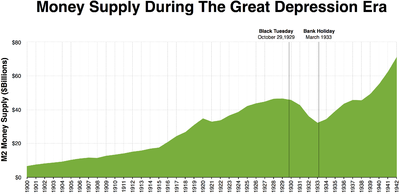
Monetarists believe that the Great Low started as an ordinary recession, but that significant policy mistakes past budgetary authorities (especially the Federal Reserve) caused a shrinking of the money supply, which greatly exacerbated the economical situation, causing a recession to descend into the Great Depression.
Public confusion [edit]
The Federal Reserve has established a library of information on their websites, all the same, many experts have spoken about the general level of public confusion that withal exists on the subject of the economic system; this lack of agreement of macroeconomic questions and monetary policy, however, exists in other countries equally well. Critics of the Fed widely regard the system as being "opaque", and i of the Fed'due south most trigger-happy opponents of his time, Congressman Louis T. McFadden, even went so far as to say that "Every effort has been made by the Federal Reserve Board to conceal its powers. ... "[88] [ unreliable source? ]
At that place are, on the other hand, many economists who support the need for an contained primal banking authority, and some have established websites that aim to clear upwardly confusion about the economy and the Federal Reserve'southward operations. The Federal Reserve website itself publishes various information and instructional materials for a multifariousness of audiences.
Criticism of government interference [edit]
Some economists, especially those belonging to the heterodox Austrian School, criticize the thought of even establishing monetary policy, assertive that it distorts investment. Friedrich Hayek won the Nobel Prize for his elaboration of the Austrian concern cycle theory.
Briefly, the theory holds that an artificial injection of credit, from a source such every bit a central bank similar the Federal Reserve, sends simulated signals to entrepreneurs to engage in long-term investments due to a favorably low interest rate. However, the surge of investments undertaken represents an artificial boom, or chimera, because the low interest rate was achieved by an bogus expansion of the money supply and not by savings. Hence, the pool of real savings and resources take not increased and do non justify the investments undertaken.
These investments, which are more than appropriately called "malinvestments", are realized to be unsustainable when the artificial credit spigot is shut off and involvement rates ascent. The malinvestments and unsustainable projects are liquidated, which is the recession. The theory demonstrates that the problem is the bogus boom which causes the malinvestments in the offset place, fabricated possible by an artificial injection of credit not from savings.
According to Austrian economics, without regime intervention, interest rates will ever be an equilibrium between the fourth dimension-preferences of borrowers and savers, and this equilibrium is just distorted by government intervention. This distortion, in their view, is the cause of the concern cycle. Some Austrian economists—only by no means all—also support full reserve banking, a hypothetical financial/banking system where banks may non lend deposits. Others may abet gratis banking, whereby the government abstains from any interference in what individuals may cull to apply as money or the extent to which banks create money through the deposit and lending bicycle.
Reserve requirement [edit]
The Federal Reserve regulates banking, and one regulation under its direct control is the reserve requirement which dictates how much money banks must go on in reserves, as compared to its demand deposits. Banks apply their observation that the majority of deposits are not requested past the business relationship holders at the same time.
Until March 2020 the Federal Reserve required that banks keep 10% of their deposits on mitt, but in March 2020 the reserve requirement was reduced to zero.[89] [21] Some countries have no nationally mandated reserve requirements—banks use their own resources to determine what to hold in reserve, however their lending is typically constrained by other regulations.[90] Other factors being equal, lower reserve percentages increases the possibility of Bank runs, such as the widespread runs of 1931. Depression reserve requirements also allow for larger expansions of the money supply by actions of commercial banks—currently the individual cyberbanking system has created much of the broad money supply of United states of america dollars through lending activity. Monetary policy reform calling for 100% reserves has been advocated by economists such as: Irving Fisher,[91] Frank Knight,[92] many ecological economists forth with economists of the Chicago School and Austrian School. Despite calls for reform, the nearly universal practice of fractional-reserve banking has remained in the The states.
Criticism of private sector involvement [edit]
Historically and to the present mean solar day, various social and political movements (such equally social credit) have criticized the involvement of the private sector in "creating money", claiming that only the regime should have the power to "make money". Some proponents also support full reserve banking or other non-orthodox approaches to budgetary policy. Various terminology may be used, including "debt coin", which may have emotive or political connotations. These are generally considered to exist alike to conspiracy theories by mainstream economists and ignored in academic literature on monetary policy.[ citation needed ]
See also [edit]
- Free banking
- History of monetary policy in the United States
- Modern Monetary Theory
- Treasury bills
References [edit]
- ^ "Federal Reserve Board - Purposes & Functions".
- ^ https://www.federalreserve.gov/aboutthefed/files/pf_3.pdf[ bare URL PDF ]
- ^ a b "Smashing Depression blogging". 17 January 2008. Archived from the original on 2014-05-28. Retrieved 2016-02-07 . Paul Krugman, "Neat Depression Blogging," January 17, 2008: "Budgetary base only gets created or destroyed through Fed actions.
- ^ Everett, Ray, Dr. "Economics: Theory and Exercise" (Seventh ed.). John Wiley & Sons, Inc. Archived from the original on 2008-09-thirteen. Retrieved 2008-01-xi .
- ^ a b c d e "A Case Study: The Federal Reserve Arrangement and Monetary Policy". Retrieved 2008-01-11 .
Every bit banks increase or decrease loans, the nation's money supply increases or decreases.
- ^ Cacy, J. A. (November 1976). "Commercial Banking company Loans and the Coin Supply" (PDF). Monthly Review. Federal Reserve Bank of Kansas City: iii. Retrieved 2008-01-25 .
Depository financial institution lending, however, is only one of several sources of potential increase in the narrowly defined money supply. Another source is the investing activity of commercial banks. As in the case of loans, when banks acquire investments, such as The states Regime securities, the public may use the proceeds to augment its M1 balances. A third source of potential increase in coin balances is the asset-acquiring activities of the Federal Reserve System. When the Federal Reserve buys U.S. Government securities, the proceeds potentially may be used by the public to add together to its M1 balances.
- ^ "Financial Times". Archived from the original on 2007-12-26. Retrieved 2008-02-03 . Willem Buiter, Professor, London School of Economic science, "Long Alive Debt", Financial Times "Maverecon Blog", October 13, 2007. "
- ^ Cox, Jeff (August 27, 2020). "Powell announces new Fed approach to inflation that could proceed rates lower for longer". CNBC.
- ^ "Voice communication by Chair Powell on new economic challenges and the Fed's monetary policy review". Board of Governors of the Federal Reserve System.
- ^ https://www.igmchicago.org/surveys/fed-strategy/
- ^ Flaherty, Edward (2003-03-06). "A Brief History of Central Banking in the U.s.a.". Department of Humanities Computing. Archived from the original on 2004-12-xiii. Retrieved 2008-02-01 .
- ^ "Is the Federal Reserve a privately owned corporation?". Federal Reserve Bank of San Francisco. Retrieved 2008-01-12 .
the 12 Federal Reserve Banks are chartered as individual corporations
- ^ "Lewis v. Usa, 680 F.2d 1239 (9th Cir. 1982)". Archived from the original on 2013-04-15. Retrieved 2008-02-17 .
The court stated "Examining the system and part of the Federal Reserve Banks, and applying the relevant factors, nosotros conclude that the Reserve Banks are not federal instrumentalities for purpose of the FTCA, but are independent, privately owned and locally controlled corporations."
- ^ "Frequently Asked Questions: board of governors". Federal Reserve Banking company of Richmond. Retrieved 2008-01-06 .
- ^ "Federal Reserve Board - Purposes & Functions". federalreserve.gov. Archived from the original on June 15, 2013.
- ^ Stevenson, Richard W. (1996-03-27). "Greenspan Calls the Fed 'Extraordinarily Well Run'". New York Times . Retrieved 2008-01-06 .
- ^ a b Hassett, Kevin. "How the Fed Works". The American Enterprise Establish for Public Policy Research. Archived from the original on 2007-12-23. Retrieved 2008-01-12 .
- ^ http://www.igmchicago.org/surveys/fed-appointments
- ^ "Federal Reserve System: The Surplus Business relationship". United States General Accounting Office. Archived from the original on 2012-08-01. Retrieved 2008-01-12 .
- ^ "Archived re-create". Archived from the original on 2014-03-12. Retrieved 2008-02-01 .
{{cite web}}: CS1 maint: archived copy as championship (link) Edward Flaherty, Section of Economics, Higher of Charleston (Due south.C.), "Debunking the Federal Reserve Conspiracy Theories", Public Eye (Political Research Assembly). - ^ a b "Policy Tools — Reserve Requirements". Federal Reserve. February three, 2021. Retrieved 2021-03-16 .
- ^ Ireland P (2019). "Interest on Reserves: History and Rationale, Complications and Risks". Cato Journal. 39 (2): 327–337.
- ^ "2008 Monetary Policy Releases". Federal Reserve. October 6, 2008. Retrieved 2021-03-25 .
- ^ "Federal Funds and Interest on Reserves - Fedpoints - FEDERAL RESERVE BANK of NEW YORK". Archived from the original on 2016-08-20. Retrieved 2011-08-29 . "Federal Funds", Fedpoints, Federal Reserve Banking company of New York
- ^ "Reserve requirements", Fedpoints, Federal Reserve Bank of New York
- ^ "The Fed - Coin Stock Measures - H.half dozen Release - December 28, 2021". www.federalreserve.gov . Retrieved 2022-01-14 .
- ^ Schenk, Robert, Ph.D. "From Commodity to Bank-Debt Money". Retrieved 2008-01-07 .
- ^ "Reserve Requirements". Retrieved 2008-01-07 .
- ^ "Frequently Asked Questions about the Public Debt". U.S. Section of the Treasury, Bureau of the Public Debt. Retrieved 2008-01-06 .
- ^ "The Federal Reserve'due south Beige Book". The Federal Reserve Banking concern of Minneapolis. Archived from the original on 2007-12-05. Retrieved 2008-01-06 .
- ^ "The Federal Reserve, Monetary Policy and the Economy". The Federal Reserve Banking company of Dallas. Archived from the original on 2007-12-22. Retrieved 2008-01-06 .
- ^ Davies, Phil. "Correct on Target". Archived from the original on 2007-12-18. Retrieved 2008-01-07 .
Federal Reserve Depository financial institution of Minneapolis
- ^ a b "Open Market Operations". Federal Reserve Bank of New York. Retrieved 2008-01-11 .
Open market place operations enable the Federal Reserve to impact the supply of reserve balances in the banking organization.
- ^ a b "The First 90 Years of the Federal Reserve Bank of Boston". Federal Reserve Bank of Boston. Archived from the original on November 17, 2007. Retrieved 2008-01-11 .
Open up market operations get the chief tool for carrying out monetary policy, with discount rate and reserve requirement changes used as occasional supplements.
- ^ a b "Reserve Requirements". Retrieved 2008-01-10 .
Federal Reserve Banking company of New York
- ^ a b Schwartz, Anna J. "Money Supply". The Curtailed Encyclopedia of Economics. Retrieved 2008-01-eleven .
If the Federal Reserve increases reserves, a unmarried depository financial institution tin make loans up to the amount of its excess reserves, creating an equal amount of deposits
- ^ a b c Simons, Howard 50. "Don't Blame (or Credit) the Fed". Archived from the original on 2006-05-xiii. Retrieved 2008-01-11 .
The Federal Reserve's open up market operations impact the level of free reserves in the banking organization. It is the lending of these gratis reserves throughout the banking system that expands the supply of credit.
- ^ a b c d Nichols, Dorothy Chiliad (May 1961). Modern Money Mechanics (PDF). Federal Reserve Bank of Chicago. p. 3. Archived from the original (PDF) on 2008-05-16. Retrieved 2008-01-11 .
The actual process of money creation takes place primarily in banks. Equally noted earlier, checkable liabilities of banks are money. These liabilities are customers' accounts. They increase when customers eolith currency and checks and when the proceeds of loans made by the banks are credited to borrowers' accounts.
Alt URL - ^ a b "Money Multiplier". Retrieved 2008-01-eleven .
... borrowers are as well inclined to convert checkable deposits into currency.
- ^ "Fact Sheets: Currency & Coins". United States Section of the Treasury. Archived from the original on 2008-01-11. Retrieved 2008-01-22 .
- ^ "Distribution of Currency and Coins". www.treasury.gov . Retrieved 2022-01-03 .
- ^ "Money Facts". U.s. Treasury, Bureau of Engraving and Printing. Archived from the original on September 28, 2007. Retrieved 2008-01-06 .
- ^ Federal Reserve Banking concern of New York, 2007 Annual Report Archived October 19, 2012, at the Wayback Machine, Note h: Federal Reserve Notes (p. 12): "The Federal Reserve Human activity provides that the collateral security tendered by the Reserve Banking company ... must be at least equal to the sum of notes applied for past such Reserve Bank."
- ^ Schenk, Robert E., Ph.D. "From Commodity to Bank-Debt Money". Retrieved 2008-01-11 .
Coin creation was a by-production of the making of the loan.
- ^ Marshall, David. "Origins of the employ of Treasury debt in open up marketplace operations: Lessons for the present" (PDF). Federal Reserve Depository financial institution of Chicago. p. 2. Archived from the original (PDF) on 2008-05-29. Retrieved 2008-02-04 .
Thus, to a close approximation, every dollar's worth of M0 in circulation is matched on the Fed's residual sheet past i dollar'south worth of U.South. Treasury securities acquired through open market place purchases.
- ^ a b Mings, Turley; Marlin, Matthew. "The Written report of Economics: Principles, Concepts & Applications" (6th ed.). The McGraw-Hill Companies.
- ^ Cunningham, Steve, Ph.D. "ECON 111 Principles of Macroeconomics: Lecture Notes". Kent Country University. Archived from the original (– Scholar search) on 2008-05-29. Retrieved 2008-01-07 . ;
- ^ Roy, Udayan. "Introduction to Economic science". Long Island University. Archived from the original on 2008-05-29. Retrieved 2008-01-12 .
Ultimately all of the newly printed cash must stop upwards as required reserves.
- ^ a b c d Daly, Herman. "Ecological Economics: The Concept of Calibration and Its Relation to Allocation, Distribution, and Uneconomic Growth" (PDF). University of Maryland. Archived from the original (PDF) on 2006-09-21. Retrieved 2008-01-xi .
- ^ "How Currency Gets into Circulation". Federal Reserve Depository financial institution of New York. Retrieved 2008-01-11 .
Virtually all of currency notes in use are Federal Reserve notes.
- ^ "Who are the largest holders of U.S. public debt?". Federal Reserve Bank of San Francisco. Archived from the original on November 2, 2011. Retrieved 2008-01-06 .
- ^ Thomas Palley, "The Case Against Budget Surpluses Archived April xiii, 2016, at the Wayback Machine," Challenge, November. - Dec., 2001, 13 - 27: "...the interest rate payable on regime debt establishes the pure risk complimentary interest rate that provides a benchmark for the entire arrangement."
- ^ "What will happen to the Fed if the national debt is paid off?". Federal Reserve Depository financial institution of San Francisco. Archived from the original on 2008-05-26. Retrieved 2008-01-06 .
- ^ Joseph H. Haslag, 1998. "Seigniorage revenue and budgetary policy: some preliminary evidence Archived October six, 2006, at the Wayback Auto," Economic and Financial Policy Review, Federal Reserve Bank of Dallas, issue Q III, pages 10-20.
- ^ Daly, Herman East (2007). Ecological Economics and Sustainable Development, Selected Essays of. Edward Elgar Publishing. ISBN978-ane-84720-101-0.
- ^ Miller, Eric (August 27, 2004). "A Treatise on the Ecological Economics of Money" (PDF). York Academy: 72. Archived from the original (PDF) on July fifteen, 2007. Retrieved 2008-01-26 .
The growth of fractional-reserve fiat money is better understood as a response to the financing needs of economical activities, not the cause of those activities.
- ^ Calvo, Guillermo A; Reinhart, Carmen M. "When Majuscule Inflows Come up to a Sudden Terminate: Consequences and Policy Options" (PDF). Imf: 20. Archived from the original (PDF) on 2008-05-29. Retrieved 2008-02-04 .
- ^ McConnell, C.; Brue, S. (2005). Microeconomics: Principles, Problems, and Policies. McGraw-Hill Professional person. p. 303. ISBN0-07-287561-5 . Retrieved 2008-02-06 . .
- ^ Schmitt, Elizabeth Dunne. "Myths vs. Realties for the United States Federal Reserve Organization". Archived from the original on 2008-09-28. Retrieved 2008-01-09 .
Professor of Economic science
- ^ BoG 2005, pp. 18–21 harvnb fault: no target: CITEREFBoG2005 (help)
- ^ Joseph Stonemason, Ali Anari, and James Kolari, "The Stock of Airtight Bank Deposits, Elapsing of Credit Channel Effects, and the Persistence of the U.S. Great Depression" Archived June nine, 2011, at the Wayback Machine: "Since Ben Bernanke's (1983) seminal paper entitled "Nonmonetary Furnishings of the Fiscal Crisis in the Propagation of the Great Low"...
- ^ "Financial Instability and the Federal Reserve as a Liquidity Provider". Archived from the original on October 11, 2006. Retrieved 2008-01-06 .
- ^ Stiglitz, Joseph (5 November 2010). "New $600B Fed Stimulus Fuels Fears of Usa Currency War". Republic Now . Retrieved v November 2010.
- ^ Wheatley, Jonathan; Garnham, Peter (5 Nov 2010). "Brazil in 'currency state of war' warning". Financial Times . Retrieved v Nov 2010.
- ^ "OIG: Office of Inspector General". oig.federalreserve.gov. Archived from the original on April xi, 2009.
- ^ FRB: OIG – Consummate List of OIG Reports. 2007 Archived October 2, 2013, at the Wayback Automobile
- ^ "The Federal Reserve Board (Senate – March 26, 1996)". Retrieved 2008-01-06 .
- ^ a b "Archived copy" (PDF). Archived (PDF) from the original on 2016-03-03. Retrieved 2008-02-02 .
{{cite web}}: CS1 maint: archived copy as title (link) Charles Bowsher, "Federal Reserve System Audits: Restrictions on GAO'southward Access", Argument by Charles Bowsher, Comptroller Full general of the United States, October 27, 1993. - ^ a b c Smale, Pauline. "Structure and Functions of The Federal Reserve System" (PDF). Congressional Inquiry Service. p. 6. Archived from the original on 2008-05-29. Retrieved 2008-02-01 .
{{cite spider web}}: CS1 maint: bot: original URL condition unknown (link) - ^ Uchitelle, Louis (1989-08-24). "Moves On in Congress to Lift Secrecy at the Federal Reserve". New York Times. Archived from the original on 2012-07-12. Retrieved 2008-01-06 .
- ^ "Archived copy". Archived from the original on 2012-02-18. Retrieved 2008-02-02 .
{{cite web}}: CS1 maint: archived copy as title (link) Federal Reserve Act, Department 11b ([12 USC 248b.]). - ^ Havrilesky, Thomas M. (1995). The Pressures on American Monetary Policy. Springer. p. 113. ISBN978-0-7923-9561-iv . Retrieved 2008-02-01 .
- ^ "Budgetary Policy". Federal Reserve Banking concern of New York. Archived from the original on December 8, 2007. Retrieved 2008-01-06 .
- ^ Archived re-create. Archived from the original on 2012-11-xiv. Retrieved 2016-05-18 .
{{cite book}}: CS1 maint: archived copy every bit championship (link) Allan H. Metzler, A History of the Federal Reserve. - ^ Bernanke, Ben S. "Money, Gold, and the Great Low". Federal Reserve Board. Retrieved 2008-01-06 .
- ^ "The Development of Banking in a Market Economy". Retrieved 2008-02-06 .
- ^ "Business Cycle Expansions and Contractions". National Bureau of Economic Enquiry, Inc. Archived from the original on 2007-10-12. Retrieved 2008-02-06 .
- ^ Purchasing Power of Money in the United States from 1774 to 2006 Archived July 19, 2016, at the Wayback Machine from measuringworth.com
- ^ "Low Aggrandizement or No Inflation". Archived from the original on 2007-11-03. Retrieved 2008-01-06 .
- ^ Anderson, Richard K. (2006). "Inflation's Economic Cost: How Large? How Certain?". Federal Reserve Bank of St. Louis – Regional Economist . Retrieved 2008-01-06 . [ permanent dead link ]
- ^ "Consumer Toll Index, 1913–". Federal Reserve Bank of Minneapolis. Archived from the original on 2007-08-12. Retrieved 2008-01-06 .
- ^ Sahr, Robert. "Inflation Conversion Factors for Dollars 1665 to Estimated 2017". Archived from the original on 2007-12-30. Retrieved 2008-01-06 .
- ^ John Taylor, "Budgetary Policy and the Long Boom" Archived October 11, 2016, at the Wayback Car, Federal Reserve Depository financial institution of St. Louis Review, November–Dec 1998.
- ^ Peter Thousand. Summers, "What Caused the Great Moderation? Some Cross-Country Evidence" Archived Oct 31, 2013, at the Wayback Machine, Kansas City Federal Reserve Bank: "The most common explanations for increased output stability include amend monetary policy."
- ^ Ghosh, Palash R. "Investor TIPS for Fighting Aggrandizement".
The annual inflation rate has been relatively low since the mid-1980s
- ^ "Personal Saving Rate". U.S. Department of Commerce, Bureau of Economic Assay. Archived from the original on 2007-12-17. Retrieved 2008-01-06 .
- ^ Hodges, Michael W. "Grandpa Economic Report series". Archived from the original on 2008-01-17. Retrieved 2008-01-06 .
- ^ "An Astounding Exposure". Retrieved 2008-01-06 .
- ^ "Board of the Governors of the Federal Reserve Organisation". Archived from the original on 2012-12-02.
In April 2007, the reserve requirement was 10% on transaction deposits and 0% on time deposits
- ^ Clinton, Kevin (1997). "Implementation of Monetary Policy in a Government with Nix Reserve Requirements". Archived from the original on 2016-03-04. Retrieved 2013-09-15 . Kevin Clinton, Bank of Canada: "Implementation of Monetary Policy in a Authorities with Zero Reserve Requirements", Banking concern of Canada Working Paper 97–eight, 1997. "A number of countries now take no requirement, such as Australia, Kingdom of belgium, Canada, Sweden and the United Kingdom."
- ^ Fisher, Irving (1997). 100% Money. Pickering & Chatto Ltd. ISBN978-1-85196-236-5.
- ^ Daly, Herman E; Farley, Joshua (2004). Ecological Economic science: Principles and Applications. Island Press. p. 250. ISBNane-55963-312-three.
External links [edit]
- Board of Governors of the Federal Reserve Arrangement
- Federal Reserve Bank of New York
- Savings rate viz Fed rate from 1954 Historical relationship between the savings rate and the Fed rate – since 1954
- United states Fed charge per unit behavior nether various presidencies since 1954
- Wages and Benefits: Real Wages (1964–2004)
Source: https://en.wikipedia.org/wiki/Monetary_policy_of_the_United_States
0 Response to "8. a bank sells a treasury bond to the fed. what happens to the money supply?"
Postar um comentário